
Criminal Cases in the Person County Courts
One clerk's office preserves two kinds of Person County criminal cases. Superior Court hears felony trials, pleas, sentencing, and later matters. District Court tries misdemeanors and infractions and handles the first stages of felony cases. Both sit within North Carolina's General Court of Justice. Person County is part of District 11 for prosecutorial, Superior Court, and District Court administration. Roxboro has no separate municipal criminal court, so city charges also enter this county and state court structure.
The official Person County courts page identifies local court services and is the best starting point for schedules, forms, and clerk access. Its published view also shows the county court landing page:
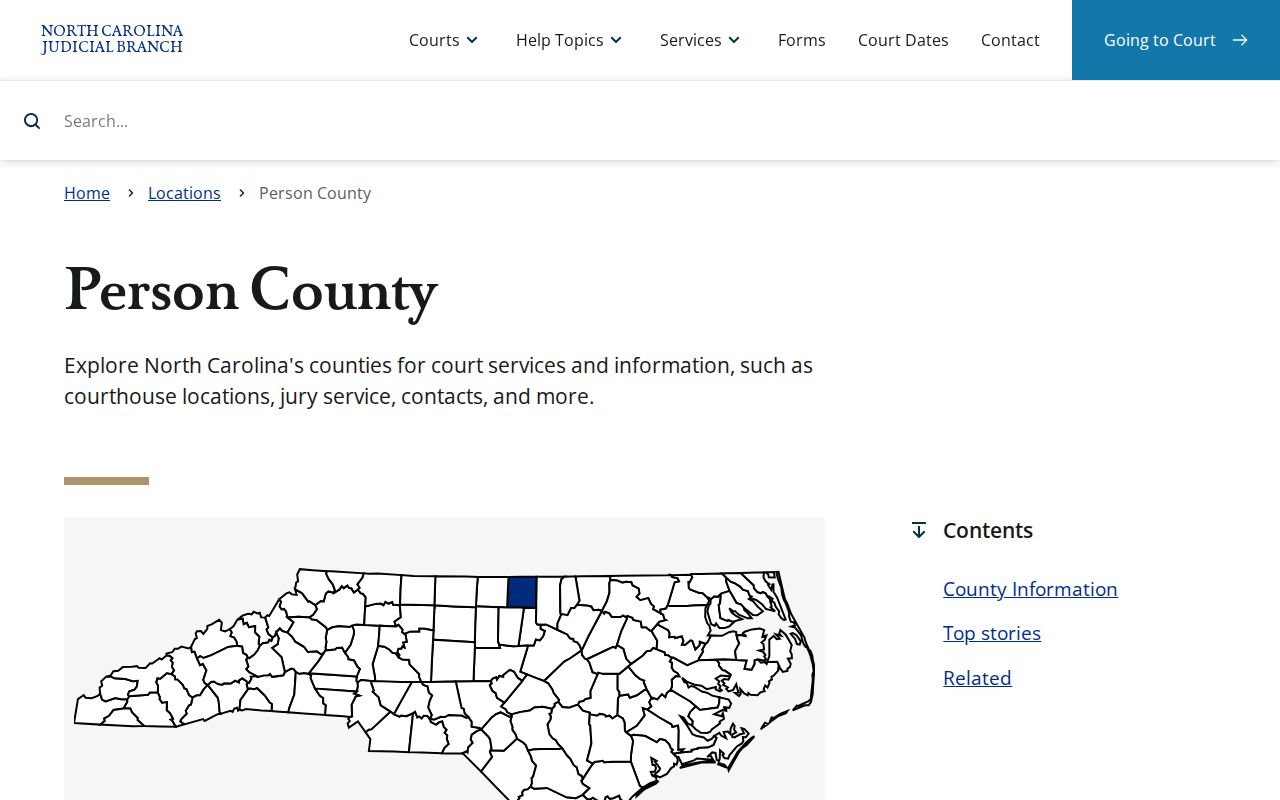
That state-managed page keeps Person County case access tied to the same court system that holds the official docket. The Clerk of Superior Court remains custodian even when the file belongs to District Court.
Person County Court Case Roles
The division shown on a Person County criminal case determines where the charge is being handled. District Court is not merely a lower-value archive. It is the trial court for misdemeanors and the place where felony preliminary proceedings begin. A felony normally reaches Superior Court through indictment or another lawful charging route. The same clerk staff maintain the records for both divisions, which reduces one common source of confusion.
| Court or office | Role in the case | Public route |
|---|---|---|
| Person County District Court | Misdemeanors, infractions, and early felony steps | eCourts, calendar search, or clerk |
| Person County Superior Court | Felony trials, pleas, sentences, and post-judgment matters | eCourts or clerk |
| Clerk of Superior Court | Official files and certified copies for both divisions | Counter, mail, public terminal, or phone |
| Magistrate | Warrants, first appearances, and release conditions | Known case docket or confirmed judicial counter |
Use the court division, county, and file number together when two entries look alike. A booking charge can change before the prosecutor files or resolves the charge, so the last court disposition carries more weight than the first jail label.
How to Search Case Records
The North Carolina eCourts Portal supports several ways to find Person County criminal court cases. A complete file number is the safest key. Name searches require more care because spelling variants and common names can return unrelated people. The separate local calendar route helps find upcoming hearings, but a calendar entry is not a final result.
- Open Portal and choose a public record or party search.
- Select Person County and enter the complete file number when known.
- For a name search, test the full legal name and reasonable variants, then confirm the county and case type.
- Open the case and compare charge sequence, dates, hearings, disposition, and judgment.
- Call or visit the Person County clerk for a certified copy, missing document, archive question, or unclear code.
| Search field | Type | Use | Person County note |
|---|---|---|---|
| Search Type | Tabs or menu | Required | Smart Search, hearing search, or payment function |
| Record Number | Text | Alternative | Use the exact case or file number |
| Party or Business Name | Text | Alternative | Verify every name match before relying on it |
| Citation Number | Text | Alternative | Enter the exact citation identifier |
| Attorney Name | Text | Optional route | Search dockets or hearings |
| Attorney Bar Number | Text | Optional route | Use the indexed bar identifier |
| Case Cross-Reference | Text | Optional route | Use an agency reference if indexed |
| Nickname | Text | Optional route | Portal supports nickname searches |
| County | Dropdown or filter | Optional narrowing | Choose Person for local results |
| Judicial Officer | Text or dropdown | Hearing route | Filters hearing calendars |
| Courtroom | Text or dropdown | Hearing route | Filters hearing calendars |
| Search or Reset | Button | Interface control | Runs or clears the query |
Person County eCourts Case Change
Person County converted to Odyssey and eCourts on April 29, 2024. That date matters when a criminal case looks thin or incomplete online. Pre-conversion documents and archived material may require help from the clerk, while newer docket events are managed in the electronic system. North Carolina completed statewide conversion on October 13, 2025, so the same Portal now spans all counties.
The Person County criminal calendar page routes readers to current schedules and court-date tools. The published calendar screen shows how hearing access sits beside, rather than inside, the full case file:
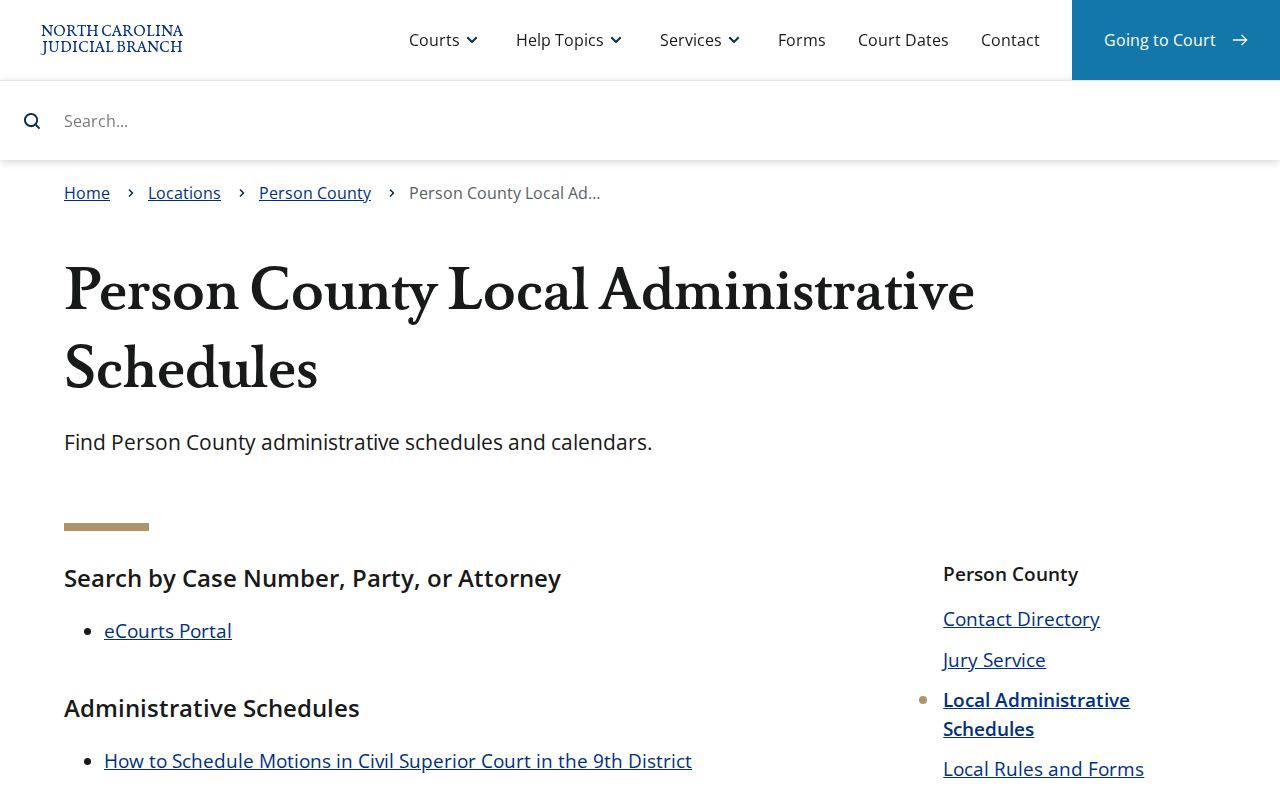
A hearing listing confirms that a matter is set. It does not establish that the hearing occurred, that a charge was resolved, or that the listed charge became the final judgment.
Note: For a sparse pre-2024 Person County case, give the clerk the file number and ask whether archived documents exist outside Portal.
What the Case File Shows
A Person County court file follows the judicial life of each filed charge. It can show process, appearances, counsel, motions, hearings, plea or verdict, disposition, sentence, costs, and public appeal entries. The file is not the same as an arrest report or jail booking. Those agency records describe the event and custody intake, while the court case records what prosecutors filed and what the judge or jury decided.
| Case number and court | County, division, location, case type, filed date, and status |
|---|---|
| Charging record | Complaint, citation, indictment, offense description, statute, class, and charge sequence |
| Docket events | Process, appearances, counsel, motions, continuances, hearings, trial, and later entries |
| Hearing details | Date, time, courtroom, judicial officer, type, and status when public |
| Disposition and judgment | Charge-level result, plea or verdict, judgment, and public financial assessments |
| Sentence and conditions | Active, intermediate, or community punishment, probation, restitution, and costs where public |
The official Person County Courthouse page supplies the building details for the clerk who maintains those files. Its courthouse view is reproduced here from that official source:
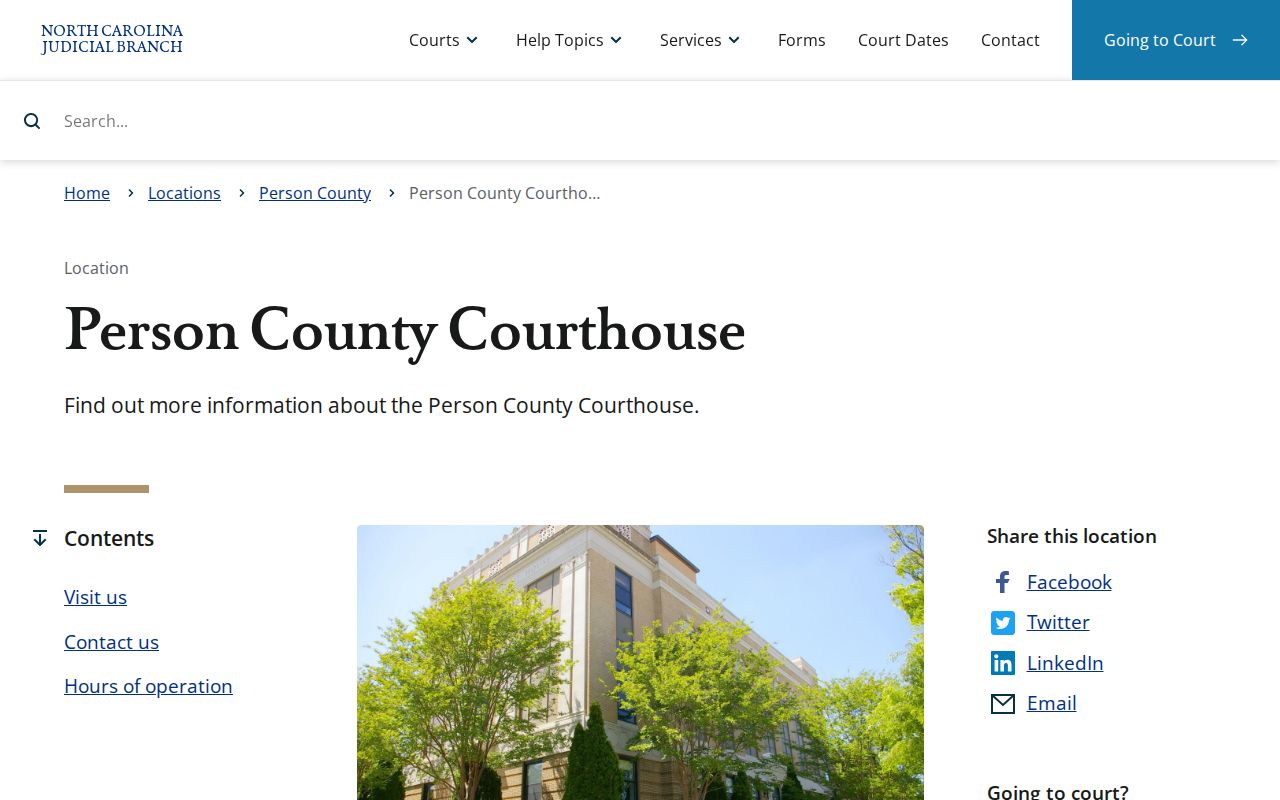
The court counter at 105 S. Main Street in Roxboro is the place to resolve a gap between Portal data and the official Person County criminal case record.
Read Person County Case Dispositions
A case status such as Pending, Disposed, or Closed describes administration. It does not, by itself, say whether a person was convicted. Read each charge row. One count may be dismissed while another ends in a plea, verdict, or deferred result. A nolle prosequi means the prosecutor formally chose not to proceed with that charge at that time. An acquittal is a not-guilty finding. A dismissal ends the charge without conviction, but its visibility can remain until an expunction is processed.
- Disposition
- The recorded outcome for a charge or case.
- Indictment
- A grand jury's formal felony accusation, often called a true bill.
- Arraignment
- The court proceeding where charges are presented and a plea is addressed.
- Judgment
- The court's formal decision following a plea, verdict, or other resolution.
- Sentence
- The punishment and conditions imposed after a conviction.
North Carolina class and prior-record rules affect punishment. The Judicial Branch punishment grids provide the official framework shown in the Person County court image below:
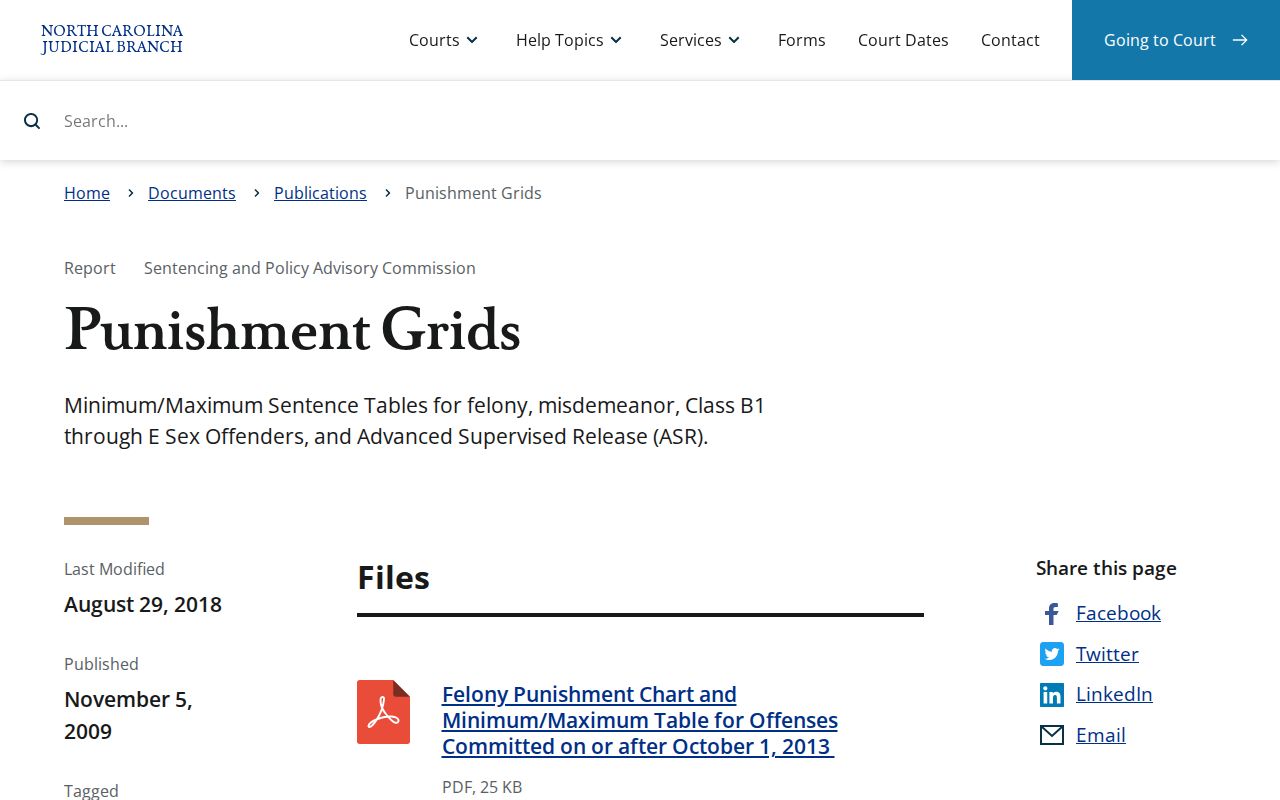
The grid helps explain a sentence range, but the judgment and offense-date law control the actual Person County case.
Stages of a Criminal Case
A Person County misdemeanor usually remains in District Court. A felony begins with early District Court steps and ordinarily moves to Superior Court after indictment. The District Attorney for Prosecutorial District 11 makes charging and plea decisions. Defense counsel appears, the docket records motions and continuances, and the case ends through dismissal, plea, or trial. Judgment and sentence follow a conviction, with appeal or post-conviction entries possible later.
Case flow: Charges Filed › Arraignment › Pretrial › Plea or Trial › Disposition › Sentencing
This sequence is more useful than reading the first arrest charge alone. Filed charges can be reduced, replaced, added, or dismissed. In Person County criminal court cases, the final charge-level disposition and judgment reveal the result.
Certified Person County Case Records
Portal is a public access copy, not a certified official record. A person who needs a certified single-county name search may submit form AOC-CR-314 at the Person County clerk's counter or by mail. The published fee is $25. Free noncertified searches can also be run on public computers at a North Carolina courthouse, with a county or statewide choice. The clerk can also address certified documents, archived files, and public material that does not appear online.
Person County Clerk of Superior Court
105 S. Main Street
Roxboro, NC 27573
336-503-5200
Monday-Friday, 8:30 a.m.-5:00 p.m.
For payment choices, the official Person County payment page explains mail, counter, and eligible online routes. Its published payment view appears below:
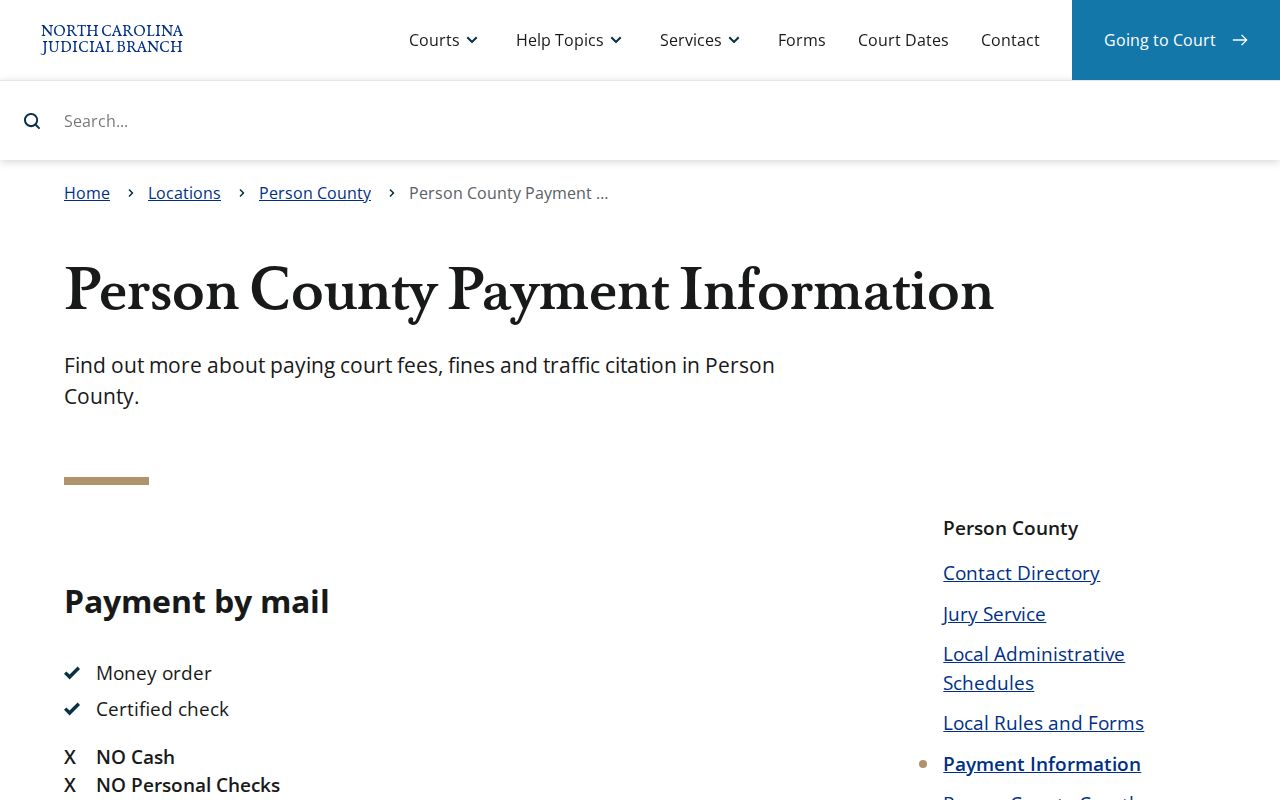
Mail payments accept money order or certified check, not cash or personal checks. Counter payments may use cash, card, money order, or certified check, with card processing fees.
Access & Restrictions
North Carolina law generally supports inspection of public court records. G.S. 7A-109 directs clerks to permit court-record inspection subject to law and reasonable rules. Public access does not make each part of every Person County criminal case visible online. Juvenile files, sealed or expunged matters, protected victim information, personal identifiers, and restricted documents remain outside normal public view.
Unreturned warrants are also not ordinary public Portal documents. If a known case is missing, first verify spelling, county, and file number. Then ask the clerk whether the record is archived, restricted, sealed, or not yet synchronized. The inspection rule in G.S. 132-6 supports access to public records at reasonable times, but it does not override a more specific confidentiality law.
Person County Case Cost Channels
Case costs and record-copy charges are separate questions. The Person County payment page covers money owed on eligible court cases. The clerk controls copies and certification. A card processing charge may apply at the cashier or online. The research did not identify a current Person County per-page copy schedule, so call the clerk before ordering a large file rather than assuming the cost.
A payment balance does not explain the whole criminal judgment. Read the filed disposition, sentence, and cost entries together. If Portal marks a case eligible for online payment, that status is a payment function, not a new finding of guilt. For the wider path from an arrest to the court result, the county's arrest history record routes explain which agency creates each earlier file.
Note: Quote the Person County file number whenever calling about costs, certified copies, archived documents, or an unclear docket entry.